
Our products use LEDs, which comes with many benefits – but, as it turns out, there can be huge differences between the variety of LEDs out there. So now, we’ll enlighten you on the topic and just why our LEDs are at the highest of quality. Why so? Let us explain:
There are big differences between the different LEDs being used on the market. That’s why we now want to explain to you why our LEDs are of the highest quality. Let’s explain:
Our LEDs are dual LEDs.
With dual LEDs you can experience the power of all wavelengths at the same time. With our dual LEDs you can switch between red light (R), near infrared light (NIR) or both at the same time (R/NIR). Another advantage is that you get a uniform light distribution onto your body.
Why is this so special?
Uniformity has been one of the biggest obstacles in our market. One problem with the light output of LEDs is that the light is not emitted evenly across a surface. The light emission is much more concentrated in the center than on the sides of the lense. Only with evenly distributed light on the skin, the maximum amount of light can be absorbed by the skin and therefore body. Only then, can maximum benefits and efficiency be achieved.
Even when using only one wavelength (e.g. only red light at 660nm for superficial application or near-infrared light at 850nm for deep tissue penetration), the light intensity stays the same. Previously or as in the case with many competitors out there, when using one wavelength, only half of the LEDs are operational, meaning half the intensity. With us ALL LEDs are operating at the same intensity, unaffected by which light mixture you’re choosing. We’ve already mentioned it a few times: The premise of all red light applications is simple: the more even the light falls on your skin, the better.
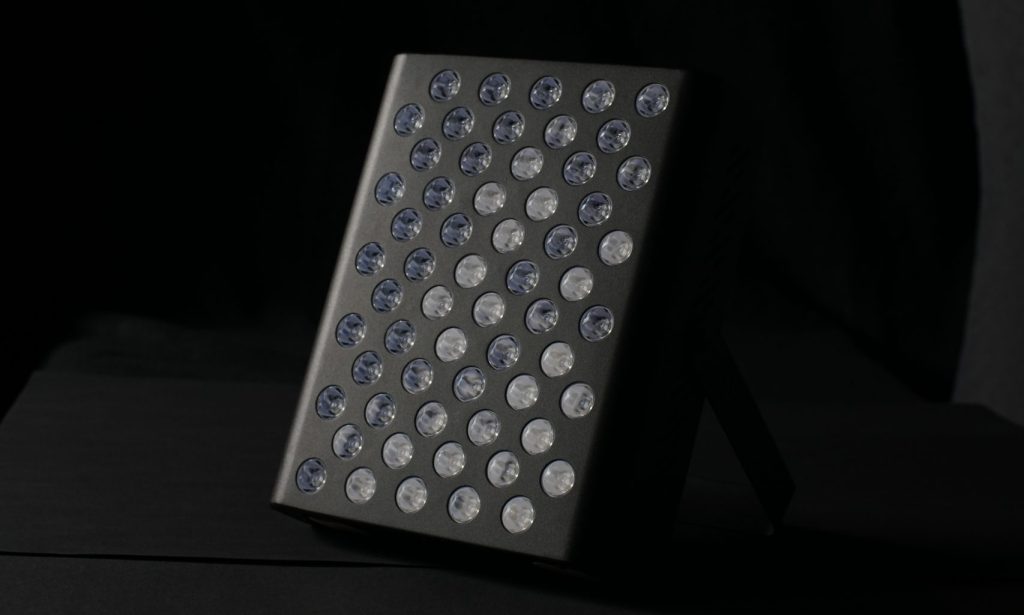
30 degree beam angle
The beam angle is essential as even coverage is the key of a useful red light therapy device. A beam angle that is too wide means that the LED loses intensity and therefore usefulness. If the beam angle is too narrow, the coverage is probably not sufficient and you should stay further away from your device. With a controlled beam angle, we can radiate the light more evenly and densely, focusing it exactly on the area you want it to hit on your body. With many other devices, the light is distributed throughout the room, which creates a great atmosphere but is not an efficient treatment environment. Most studies have focused on laser and beam angles of 30 degrees and below. The LEDs in our devices are designed with a 30 degree beam angle to ensure you get the optimal intensity and coverage at the same time.